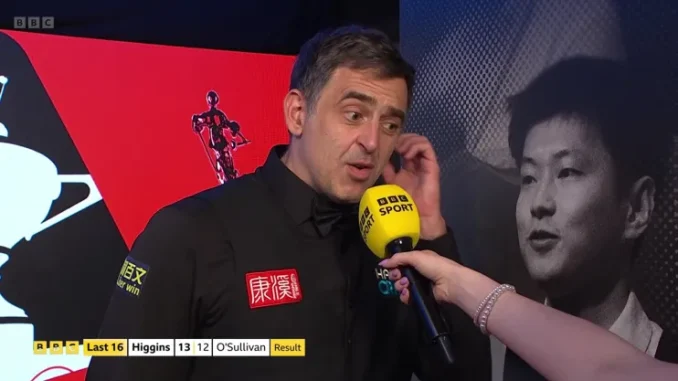
Ronnie O’Sullivan has addressed the circumstances behind his abrupt exit from the arena during his World Snooker Championship clash with long-time rival John Higgins, offering insight into a moment that left fans puzzled and commentators speculating.
The seven-time world champion was in the midst of a tense encounter at the Crucible Theatre when he suddenly left the playing area during a mid-session interval, appearing visibly frustrated. While players routinely step away during scheduled breaks, O’Sullivan’s demeanor and the timing of his departure drew particular attention, especially given the high-stakes nature of the match and his history of unpredictable behavior.
Speaking after the match, which he ultimately lost to Higgins, O’Sullivan was candid about his state of mind. He explained that the decision to leave abruptly was not intended as a sign of disrespect to his opponent or the tournament, but rather a necessary step to regain composure. According to O’Sullivan, he had been struggling internally throughout the session, battling a combination of mental fatigue and dissatisfaction with his own performance.
“I just needed a moment,” he said. “Sometimes when things aren’t going right out there, it can feel overwhelming. I didn’t want to sit there and let it get worse, so I took myself away to reset.”
O’Sullivan acknowledged that his body language may have suggested deeper frustration, but insisted that such reactions are part of his ongoing effort to manage the emotional intensity of top-level competition. Known for his openness about mental health challenges and the pressures of professional snooker, he emphasized that stepping away briefly can be a healthier alternative to allowing frustration to spiral.
The match itself was a closely fought contest, with Higgins demonstrating his trademark composure and tactical discipline. Capitalizing on key errors from O’Sullivan, Higgins gradually built momentum and maintained control during crucial frames. Despite flashes of brilliance from O’Sullivan, he was unable to sustain consistency, ultimately conceding defeat to his fellow veteran.
Observers noted that O’Sullivan’s struggles were not purely technical. His shot selection and pace appeared affected at times, reinforcing his own assessment that the issue was as much mental as it was physical. Even so, he was quick to credit Higgins for his performance.
“John played solid,” O’Sullivan admitted. “He punished my mistakes and stayed focused. That’s what you have to do at this level.”
The incident has once again highlighted O’Sullivan’s complex relationship with the sport. While widely regarded as one of the most naturally gifted players in snooker history, he has often spoken about the challenges of maintaining motivation and coping with the demands of the professional circuit.
Despite the defeat, O’Sullivan suggested he remains committed to competing, though he offered no definitive timeline for his next appearance. For fans, his explanation provides context rather than closure—another glimpse into the mindset of a player whose brilliance is matched only by his unpredictability.
In the end, his abrupt exit was less about controversy and more about self-preservation, a reminder that even the game’s greatest talents are not immune to moments of vulnerability under pressure.

Be the first to comment