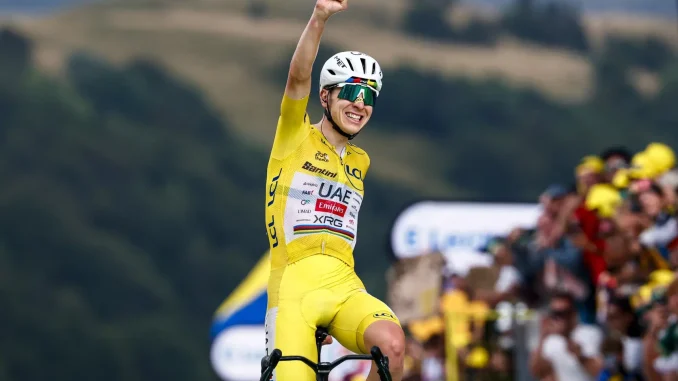
Tadej Pogačar is returning to a race that holds a special place in his career, seven years after announcing himself as one of cycling’s brightest young talents. The Slovenian superstar is set to compete in the Vuelta a España again in 2026, bringing him back to the scene of his breakthrough as a professional rider.
Pogačar’s first Vuelta appearance came in 2019, when he was only 20 years old. He arrived in Spain with relatively modest expectations, primarily to gain experience and support his UAE Team Emirates teammate Fabio Aru. Instead, the young Slovenian produced one of the most memorable performances of the race, winning three stages and finishing third overall.
At the time, Pogačar was talented but still learning how to manage a three-week Grand Tour. His performances were sometimes aggressive and unpredictable, reflecting the enthusiasm of a rider who possessed enormous physical ability but had yet to develop the tactical maturity that would later become one of his greatest strengths.
Seven years later, the difference is remarkable.
Pogačar now returns as one of the most accomplished cyclists of his generation. His career has developed at a breathtaking pace, with victories at the Tour de France, Giro d’Italia, major one-day classics and numerous prestigious stage races. Yet the Vuelta remains one of the biggest prizes missing from his collection.
That unfinished business is one of the major reasons his return to Spain has generated so much attention.
Pogačar has already won the Tour de France five times and has established himself as a dominant force across different types of races. He has also demonstrated an unusual ability to compete successfully on both steep mountain climbs and demanding one-day classics.
The Vuelta, however, has remained elusive.
His return in 2026 therefore represents more than another Grand Tour appearance. It is also a chance to revisit the race that helped introduce him to the wider cycling world.
When Pogačar looks back at the 2019 edition, he can see a much younger version of himself. He had the strength to compete with experienced Grand Tour riders, but he was still learning how to use that strength effectively.
His third-place finish behind Primož Roglič and Alejandro Valverde was nevertheless extraordinary. Pogačar was the best rider in the race during the final week, winning three stages and climbing his way onto the podium.
The performance offered an early glimpse of what was to come.
Since then, Pogačar has transformed himself from an exciting young prospect into the leading figure of professional cycling. His ability to attack, recover and compete consistently at the highest level has made him one of the sport’s most recognizable stars.
His return to the Vuelta also comes at a fascinating point in his career.
There are few major achievements left for Pogačar to chase. He has conquered the Tour, won the Giro and collected an extraordinary number of victories in the sport’s biggest races. The Vuelta is therefore a natural target for a rider whose ambitions extend beyond simply winning the biggest race every summer.
Completing the three Grand Tours would give Pogačar another significant achievement and strengthen his claim as one of the most versatile cyclists of the modern era.
However, winning the Vuelta will not necessarily be straightforward.
The biggest challenge could be managing his body after another demanding Tour de France campaign. Racing two Grand Tours in the same season requires enormous physical and mental commitment, particularly when the second race features difficult mountain stages.
Pogačar has approached the period between the Tour and Vuelta carefully. Rather than immediately returning to intense competition, he has focused on recovery and maintaining his condition. The goal is to arrive in Spain mentally fresh while retaining the fitness necessary to survive the race’s toughest stages.
His preparation has also included reconnaissance of several climbs that could play a decisive role during the Vuelta.
That knowledge could prove valuable as the race develops. Pogačar’s experience is now dramatically different from what it was in 2019. He understands when to attack, when to conserve energy and how to respond to his biggest rivals.
Among those rivals is Roglič, who knows the Vuelta better than almost anyone. The four-time champion remains one of the strongest stage racers in the peloton and could provide Pogačar with a serious challenge.
Felix Gall, Richard Carapaz and Oscar Onley are also expected to feature prominently in the fight for the general classification.
Yet much of the attention will remain on Pogačar himself.
The central question is not whether he has the ability to win the Vuelta. His career has already demonstrated that he possesses the required talent. Instead, the uncertainty concerns how much energy he will have after the Tour and how aggressively he will choose to race.
If Pogačar arrives in top condition, he could quickly establish himself as the rider everyone else has to beat.
His return also carries an emotional element. Seven years ago, he was an inexperienced youngster trying to learn the demands of Grand Tour racing. Today, he comes back as the defending Tour champion and one of the most decorated riders in the peloton.
The contrast illustrates just how extraordinary his career has been.
The 2019 Vuelta was where the cycling world received one of its first major warnings about Pogačar’s potential. The 2026 edition could be where he finally completes another important chapter of his remarkable career.
For Pogačar, returning to the scene where it all began is an opportunity to measure how far he has travelled since that breakthrough performance.
And with the Vuelta still missing from his list of Grand Tour victories, the Slovenian has every reason to believe that his return to Spain could become another defining moment in an already historic career.


Be the first to comment