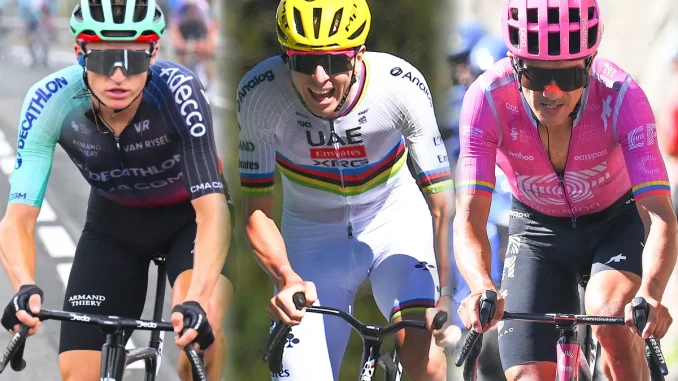
The first two Grand Tours of 2026 have already been decided, with Jonas Vingegaard winning the Giro d’Italia and Pogačar taking the Tour de France. Attention now turns to the 81st Vuelta a España, which begins with a time trial in Monaco before heading through France and into southern and eastern Spain.
The route should suit Pogačar, particularly the demanding climbs in the Sierra Nevada. Having not raced the Vuelta since finishing third as a 20-year-old in 2019, the Slovenian is returning with the red jersey firmly in his sights.
1. Tadej Pogačar
Pogačar is overwhelmingly the rider to beat. Paris-Roubaix is the only race he has failed to win this season, while his Tour de France victory came by more than six minutes.
He also has one of the strongest teams in the race, with riders such as João Almeida, Jay Vine and Pavel Sivakov available to support him. Barring illness, crashes or an unexpected collapse in form, it is difficult to see anyone stopping him from completing his Grand Tour collection.
2. Felix Gall
Gall arrives in Spain after an impressive Giro d’Italia, where he finished second behind Vingegaard. His victory at the Vuelta a Burgos further underlined his excellent preparation.
The Austrian has deliberately kept his racing schedule light since the Giro, returning at San Sebastián before winning Burgos. With extensive Grand Tour experience and only six racing days since May, he should arrive fresh and well prepared.
Beating Pogačar appears unlikely, but Gall looks like one of the strongest candidates to finish second.
3. Oscar Onley
Onley was one of the breakout riders of last season, finishing third at the Tour de Suisse and fourth at the Tour de France. His 2026 campaign was disrupted by illness and a serious crash, but his performance at the Vuelta a Burgos suggests he is back to his best.
He finished second behind Gall, won a stage and claimed both the mountains and points classifications. At just 23, the British rider could be a serious podium threat on the steep climbs of his first Vuelta.
4. Richard Carapaz
Carapaz’s exact objective remains uncertain. He could target the general classification, as he has done with previous Vuelta podium finishes, or concentrate on stage victories.
His recent Tour de France performance makes him impossible to overlook. The Ecuadorian won two Alpine stages and claimed the polka-dot jersey, taking his career Grand Tour stage tally to 10.
The main question is whether he can maintain that level after riding the Tour. If he does, another strong Vuelta performance is certainly possible.
5. Mattias Skjelmose
Skjelmose is attempting the Tour-Vuelta double after finishing sixth in France. The Vuelta route should suit his combination of climbing ability and punchy riding.
He may also benefit from having no Juan Ayuso alongside him this time, avoiding the leadership tension that existed at the Tour. The two individual time trials could be a concern, although Skjelmose performed impressively against the clock in France.
His biggest disadvantage could be Lidl-Trek’s approach, as the team may not provide a squad built entirely around his GC ambitions.
6. Enric Mas
Mas has traditionally excelled at the Vuelta, with six top-six finishes and four podiums. However, his recent Grand Tour results have been considerably less impressive.
His fifth-place finish at the Vuelta a Burgos offers encouragement. He looked consistent throughout the race and finished only 41 seconds behind Gall.
With a strong Movistar team around him and Cian Uijtdebroeks also targeting a result, Mas could once again become a major factor in the Spanish race.
7. João Almeida
Almeida finished second at last year’s Vuelta but enters this edition in a very different position. With Pogačar racing, his role within UAE Team Emirates-XRG is likely to be primarily supportive.
His own season has been badly disrupted by illness and injury. He has not completed a stage race since March and missed the Giro before withdrawing from the Tour of Poland.
His form is therefore difficult to assess, although UAE’s strength means he could still find himself fighting for a top-10 position or playing an important role in Pogačar’s bid for the red jersey.
8. Matthew Riccitello
Riccitello has progressed steadily since turning professional and already owns a fifth-place finish at the Vuelta, where he also won the young rider classification.
His 2026 season includes victories at the Tour de la Provence and Tour du Jura, alongside strong results in other stage races. He supported Paul Seixas at the Tour de France and finished 24th overall, improving as the race reached the Alps.
The major unknown is how he will handle two consecutive Grand Tours for the first time.
9. Cian Uijtdebroeks
Uijtdebroeks arrives at the Vuelta with something to prove after illness forced him to abandon the Tour de France during its opening week.
His season had previously shown promise, including seventh overall at the Tour Auvergne-Rhône-Alpes, but he has yet to establish himself as a consistent Grand Tour leader.
With Mas also heading Movistar’s GC ambitions, Uijtdebroeks may have less pressure on him. Nevertheless, another unsuccessful Grand Tour would raise further questions about his development.
10. Primož Roglič
Roglič is perhaps the hardest rider to assess. The four-time Vuelta winner is expected to start in Monaco, but his recent crash and inconsistent 2026 campaign make another overall victory seem unlikely.
Pogačar’s presence also makes the challenge considerably harder. Even a podium finish would represent an impressive result given the circumstances.
Still, writing Roglič off would be risky. The Vuelta has been his most successful Grand Tour, and he knows exactly how to manage its demanding three-week format. A top-10 finish or stage victory would not be surprising.
Other riders to watch
Several riders outside the top 10 could still make an impact. Mikel Landa is entering his final Grand Tour with Soudal-QuickStep and may focus on stage victories. Max Poole will hope to regain his previous level after a difficult season.
Carlos Rodríguez is another rider looking to rediscover the form that once produced four consecutive top-10 Grand Tour finishes. Young talents Jarno Widar and Jørgen Nordhagen will attract considerable attention, while Santiago Buitrago remains capable of a strong result if he finds his best form.
Luke Tuckwell, Lorenzo Fortunato, Iván Sosa, Guillaume Martin and Jan Hirt could also feature around the top 10 or target stage victories.
Overall outlook
Pogačar enters the Vuelta in a class of his own after dominating the 2026 season and winning the Tour de France by a substantial margin. The real battle may therefore be less about who can beat him and more about which rider can emerge as the best of the rest.
Gall, Onley, Carapaz and Skjelmose appear particularly well placed for the podium, while Mas and Roglič have the experience to outperform expectations.

Be the first to comment