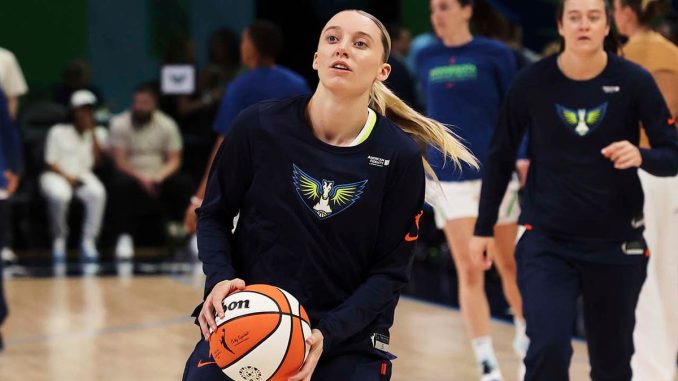
Paige Bueckers Klan: A Divisive Faction Fueling Racism, Resentment and Attacks on Black WNBA Players
The WNBA has become one of the fastest-growing sports leagues in America, bringing new audiences, rivalries and intense conversations about race, identity and representation. But alongside that growth has come an increasingly toxic online culture in which some fan groups appear more interested in attacking players than celebrating basketball. One controversial example is the emergence of what some critics have dubbed the “Paige Bueckers Klan” — a provocative label for a faction of fans who use Bueckers’ popularity to fuel resentment toward Black WNBA players.
It is important to distinguish Bueckers herself from the behavior of individual supporters. There is no evidence that Bueckers endorses racism or hostility toward Black athletes. In fact, her recent comments have pointed in the opposite direction.
In July 2026, Bueckers publicly addressed the lack of Black women serving as WNBA head coaches. She argued that Black women deserve equal opportunities in a league whose history and culture have been deeply shaped by Black women.
That statement nevertheless became part of a larger online argument surrounding Bueckers and Caitlin Clark. Both young stars have frequently been compared, and their fanbases sometimes treat the comparison as a competition extending beyond statistics and performances. Instead of simply debating who is the better player, some online discussions have turned into arguments about race, privilege and which athletes receive the most attention.
The problem emerges when legitimate basketball disagreements become racialized attacks. Black WNBA stars have repeatedly faced criticism that goes beyond ordinary sports trash talk, with social-media conversations sometimes portraying Black players as obstacles to the success of white stars. That kind of rhetoric damages the league because it shifts attention away from the players’ skills and toward racial resentment.
The controversy surrounding Clark has demonstrated how complicated these conversations can become. Critics have pointed to an online faction of her supporters that portrays her as a victim whenever she faces criticism, while other fans argue that the attention surrounding her has been unfairly weaponized against Black players.
Bueckers has increasingly found herself at the center of that debate, even though she has publicly resisted being defined by comparisons with Clark. Earlier discussions surrounding the two players have emphasized that they are different athletes with different journeys, despite constant attempts to place them against each other.
The “Paige Bueckers Klan” label therefore says more about an online faction than about Bueckers herself. Using such a label can be provocative, but it also reflects a genuine concern about how sports fandom can become tribal. When supporters begin treating another player’s race, identity or popularity as a threat, competition turns into something much uglier.
The WNBA does not need that kind of division. Its history includes generations of Black women who built the league, carried its teams and helped establish women’s basketball as a professional sport. The absence of Black women head coaches in 2026 has itself become a significant talking point, making Bueckers’ comments particularly relevant to the broader conversation about representation.
There is nothing wrong with supporting Bueckers passionately. There is nothing wrong with believing she is one of the league’s brightest young stars. There is also nothing wrong with comparing her statistics with Clark’s or debating their impact on women’s basketball.
The line is crossed when support for one athlete becomes hatred toward another.
WNBA fandom can be competitive without becoming racist, passionate without becoming abusive and divided over basketball without turning Black players into targets. Bueckers’ own comments about equal opportunity provide an opportunity to move the conversation in that direction.
Ultimately, the future of women’s basketball should not be defined by which fanbase can shout the loudest. It should be defined by the players on the court, the competition between teams and the continued growth of a league that has room for stars of every background. The challenge for fans is to celebrate their favorites without turning somebody else’s success into an enemy.
Be the first to comment