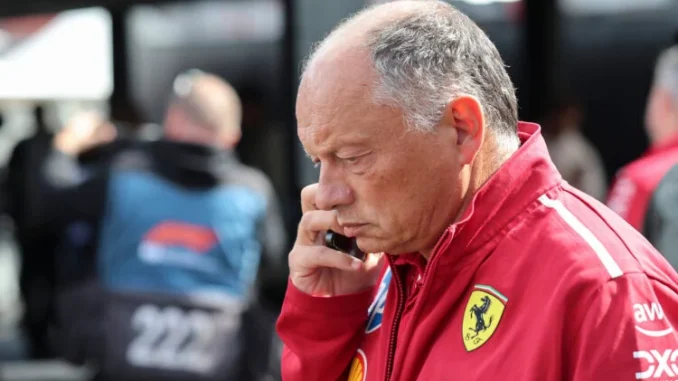
Fred Vasseur’s Ferrari future now depends on achieving a single target in the 2026 F1 season as he continues daily communication with Kimi Räikkönen.
Fred Vasseur’s future at Ferrari is increasingly being framed around one clear objective: delivering results in the 2026 Formula 1 season. With the sport set to undergo one of its most significant regulation overhauls in decades, the next two years represent a defining period not just for teams and drivers, but for team principals as well. For Vasseur, that reality is becoming impossible to ignore.
Since taking over as Ferrari team principal, Vasseur has been tasked with restoring stability and competitiveness to a team that has often struggled to convert potential into sustained success. While Ferrari has shown flashes of progress under his leadership, consistency and championship contention have remained elusive. As a result, internal expectations appear to be narrowing toward a single benchmark: Ferrari must emerge as a genuine title contender under the 2026 regulations.
The importance of 2026 cannot be overstated. New power unit rules, revised chassis regulations, and a broader philosophical reset across the grid mean that teams are effectively being given a clean slate. For Ferrari, this represents both an opportunity and a risk. Get it right, and the Scuderia could re-establish itself at the front of Formula 1. Get it wrong, and questions about leadership and direction will inevitably intensify.
Vasseur’s role in shaping Ferrari’s 2026 project has therefore become central to his long-term future. Reports suggest that his position is closely tied to how effectively Ferrari prepares for and executes this transition. Rather than short-term race wins, the focus is said to be on structure, technical clarity, and long-term competitiveness. In that sense, Vasseur is being judged less on immediate results and more on whether Ferrari is building the foundations of a championship-winning team.
Adding an intriguing layer to the situation is Vasseur’s continued communication with former Ferrari driver and 2007 world champion Kimi Räikkönen. While Räikkönen is long retired from Formula 1, his experience, perspective, and famously blunt outlook are still highly valued within the paddock. Regular contact between the two suggests that Vasseur is open to external viewpoints and historical insight as Ferrari navigates its future.
Räikkönen’s time at Ferrari spanned both success and frustration, giving him a unique understanding of the pressures that come with leading or driving for the team. Even informal dialogue could offer valuable perspective on team culture, driver management, and handling expectations in Maranello—areas that have often proven just as decisive as raw performance.
Ultimately, Vasseur’s situation reflects the broader reality at Ferrari: progress is expected, but patience is limited. The 2026 season looms as a verdict on the current leadership era, and every decision made now is being measured against that distant but critical target.
If Ferrari enters the new era as a frontrunner, Vasseur’s position will likely be secure. If not, the spotlight will turn sharply toward the man tasked with guiding the team through its latest reinvention. In Formula 1, timing is everything—and for Fred Vasseur, the clock is clearly ticking toward 2026.


Be the first to comment