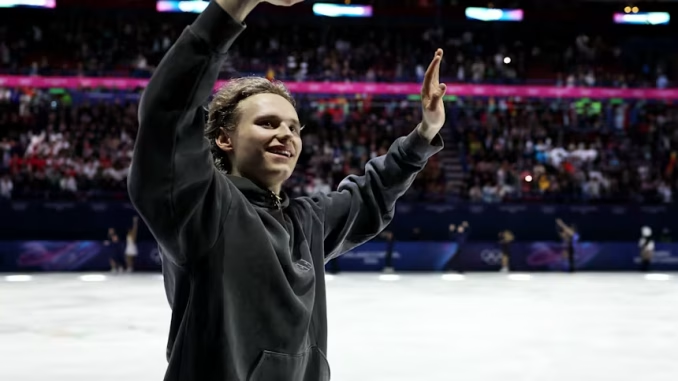
Ilia Malinin has opened up about how his disappointing eighth-place finish at the Milano Cortina 2026 Winter Olympics changed his outlook on figure skating, revealing that he is learning to put his own happiness and freedom ahead of outside expectations.
The American figure skater, widely known as the ‘Quad God’, discussed the experience during a conversation with Olympic skiing champion Mikaela Shiffrin on her podcast, What’s the Point with Mikaela Shiffrin, published on 28 October 2026. Their discussion explored the pressure of elite sport, the expectations placed on successful athletes and Malinin’s determination to regain control of his career.
Malinin entered the Winter Olympics as one of the leading contenders for the men’s individual figure skating gold medal. Having established himself as one of the sport’s most accomplished performers, he carried enormous expectations into his Olympic debut.
However, his individual competition did not unfold as planned. After taking the lead in the short programme, he struggled during the free skate, missing several planned quadruple jumps and falling twice. He ultimately finished eighth overall, while Kazakhstan’s Mikhail Shaidorov claimed the gold medal.
Malinin had already helped the United States win gold in the team event, but the individual result proved a difficult experience for the young skater.
Malinin Opens Up About the Pressure Behind His Olympic Experience
Speaking to Shiffrin, Malinin explained that the difficulties surrounding his Olympic performance extended beyond what happened on the ice.
He described feeling overwhelmed by expectations and the demands of people around him, including those connected to the sport’s governing structures. The pressure left him feeling as though he had lost control over important parts of his own journey.
Malinin admitted that he had become frustrated with the feeling that other people expected him to meet their demands without necessarily considering what he wanted for himself.
Reflecting on that experience, he explained that he had started learning to say no and establish clearer boundaries.
For Malinin, the lesson was not simply about dealing with a disappointing result. It was also about recognising that his career and decisions should not be entirely shaped by other people’s expectations.
He expressed frustration with an environment in which athletes can feel they have limited freedom to make their own choices. He wants to change that approach and become more comfortable deciding what is right for him.
‘I Have to Skate for Myself’
One of the central messages from Malinin’s conversation with Shiffrin was his determination to reconnect with the personal reasons he fell in love with skating.
The American explained that he sometimes felt pressure to satisfy other people rather than concentrate on his own ambitions. As his reputation grew, extraordinary performances increasingly became what people expected from him.
Instead of celebrating the difficulty of his jumps, spectators and observers could begin treating them as routine achievements.
That expectation created an additional burden for an athlete whose reputation rests on pushing the technical boundaries of figure skating.
Malinin acknowledged that constantly trying to please others could leave him feeling burnt out. His new approach is to remember that he is the person competing and that he must retain ownership of his decisions.
His message was clear: “I have to skate for myself.”
The statement reflects a broader change in how he wants to approach his career, placing greater importance on personal fulfilment, creative freedom and the enjoyment of performing.
From Olympic Disappointment to a New Mindset
Malinin’s Olympic experience was particularly surprising because of his outstanding form before arriving in Italy. He had won 14 consecutive individual competitions dating back to 2023 and was regarded as the favourite for the Olympic title.
His eighth-place finish demonstrated how difficult it can be to reproduce years of success under the extraordinary pressure of the Olympic Games.
Rather than allowing that result to define his career, Malinin is using the experience to reconsider what success means to him.
His conversation with Shiffrin also highlighted the importance of allowing athletes to make decisions about their own lives and careers, rather than measuring their worth exclusively through medals, records and public expectations.
The discussion comes as Malinin continues to establish his identity beyond the ‘Quad God’ nickname, exploring a more creative approach to skating and describing himself with the new moniker ‘Chaos God’.
Looking Ahead
At 21, Malinin still has considerable time to build on his achievements and prepare for future Olympic opportunities, including the 2030 Winter Games in the French Alps.
His immediate focus, however, is not simply on adding more difficult jumps or collecting further titles. He is also trying to develop a healthier relationship with competition and the expectations that accompany international success.
His experience offers a reminder that even athletes celebrated for extraordinary technical ability can struggle when external pressure becomes overwhelming.
For Malinin, the disappointment in Milano Cortina may ultimately become an important turning point. He remains committed to figure skating, but he wants his future to be guided more by his own ambitions than by the demands of others.


Be the first to comment