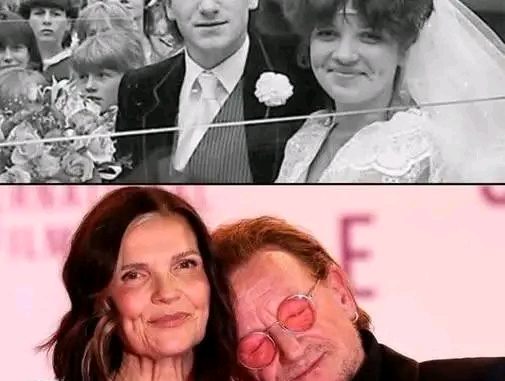
Before millions of people called him Bono, a teenage girl chose to stand by Paul Hewson when his life was shattered.
Ali Stewart met Paul at Mount Temple School in Dublin. She was 12, and he was just a year older. U2 didn’t exist yet; there were no records, stadiums, or massive crowds. They were just two students who happened to see each other in the hallways and on the school bus.
Soon after, Paul’s life changed drastically.
In September 1974, his mother, Iris, suffered a ruptured brain aneurysm while attending his own father’s funeral. She died three days later. Paul was 14.
The house remained occupied by his father and brother, but he felt he had lost the center of his family. He became more rebellious, impulsive, and difficult to understand. Many of the songs he would write decades later would continue to return to that absence.
Ali couldn’t replace her mother or erase the grief. She simply stayed close.
She was there for him during a time when Paul was still trying to understand what to do with the sadness, anger, and feelings of abandonment. Over time, that friendship deepened into something more.
In 1976, they formally began their relationship. Around that same time, Paul answered an ad posted at school by a student named Larry Mullen Jr., who was looking for musicians to form a band.
The group wasn’t yet called U2.
They rehearsed with difficulty, lacked experience, and offered no guarantees for the future. While Paul was trying to find his voice in front of a microphone, Ali was building his own life, unaware that this young man would eventually become one of the most recognized figures in rock.
They married on August 31, 1982, at All Saints Church in Raheny. U2 had already released their first albums, but they were still far from the worldwide fame that would soon follow.
Success transformed almost everything around them.
The endless tours, hotels, photographers, and crowds arrived. However, Ali never wanted to be simply “Bono’s wife.” She resumed her studies and in 1989 earned a degree in Social Sciences, Politics, and Sociology from University College Dublin, just weeks after the birth of Jordan, the couple’s first child.
Eve, Elijah, and John followed.
Ali also developed extensive humanitarian and environmental work. In 1993, she traveled to Belarus to participate in a documentary about the consequences of the Chernobyl nuclear disaster. Since 1994, she has collaborated with Chernobyl Children International and visited communities affected by radiation.
In 2005, she participated in the creation of Edun, a brand that sought to promote more responsible business relationships and generate production opportunities in Africa. The project faced difficulties, but it reflected something Ali had championed for years: aid should not be limited to charity, but should strive to create independence and dignified work.
Her presence was also subtly present in U2’s music.
During the sessions for The Joshua Tree, Bono forgot Ali’s birthday because he was so focused on the recording. As an apology, he wrote “Sweetest Thing.” When the song was re-released years later, Ali requested that the proceeds go to children affected by Chernobyl.
Bono has acknowledged that his marriage hasn’t survived thanks to a perfect formula. He has described it as a relationship sustained by something that can be even more resilient than infatuation: friendship.
2026 marks fifty years since they started dating.
Half a century during which he went from being a wounded teenager to filling stadiums, and she from being his schoolmate to building her own identity as a mother, activist, and businesswoman.
Ali didn’t meet a rock star.
She met a young man who had lost his mother, argued with the world, and still didn’t know what to do with his grief.
She couldn’t imagine who he would become.
She decided to be with him when there was still no fame to make staying.


Be the first to comment