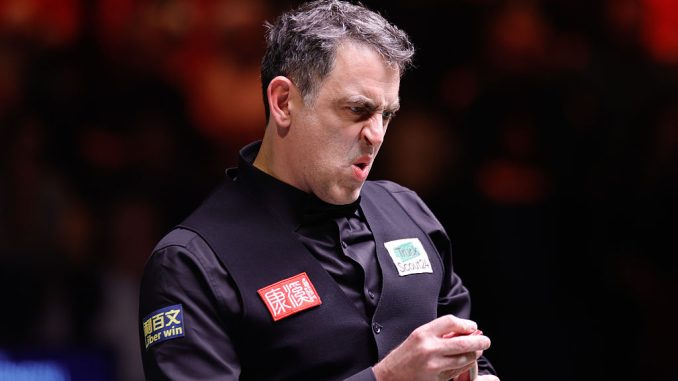
Ronnie O’Sullivan sees worrying trend develop as snooker’s GOAT continues to struggle
Ronnie O’Sullivan is one of the most decorated players in snooker history. A seven-time (some records say eight-time) world champion and holder of numerous Triple Crown titles, he is routinely described as the sport’s GOAT — a genius with cue action, pace, and break-building skills that have thrilled fans for decades. Yet recent events suggest an unsettling pattern in his competitive form that is troubling observers and supporters alike.
The most immediate sign of struggle came at the 2026 German Masters in Berlin, where O’Sullivan was knocked out in the early rounds by long-time rival Ali Carter, losing 5–3 despite mounting a spirited comeback from 3–0 down. Carter, now 46, has generally been on the receiving end of O’Sullivan’s dominance, but this time he prevailed in the critical closing frames, underlining that the 50-year-old Rocket may no longer be the near-unstoppable force of old.
This defeat followed a fractured season in which O’Sullivan has picked his battles carefully, often for reasons other than form. He withdrew from the prestigious Masters tournament on medical grounds, a decision that marks the second successive year he has missed this major event, leaving fans puzzled and critics questioning his priorities. His absence was officially attributed to health concerns, but the precise issue remains undisclosed.
Beyond these headline results, there is a broader context of inconsistency creeping into his performances. Last season, O’Sullivan suffered a first-round exit at the UK Championship, losing to China’s Zhou Yuelong — a rare and disappointing result for a player of his calibre and history at that event.
These results are not just isolated losses; they fit into a pattern noted by commentators and fans: a decline in sustained excellence. Historically, even when not at his best, O’Sullivan could produce spectacular snooker over the course of a tournament. Now, he appears to struggle to maintain high-level focus from match to match and event to event, sometimes producing flashes of brilliance but failing to string together consistent deep runs in big competitions. This has been highlighted by his early exits and withdrawals, suggesting something more than mere competitive variance.
One major factor feeding this worrying trend is O’Sullivan’s own admission of mental fatigue, self-doubt, and pressure management issues. While he’s candidly discussed mental health throughout his career, recent comments imply this is not just casual reflection but a genuine challenge: he’s talked about anxiety around practising, match pressure, and difficulty finding enjoyment in competition. Some reports suggest that at times he has felt almost “scared” to approach a snooker table, finding simple practice sessions daunting — a striking contrast to his earlier years when intense practice was routine.
Another aspect is selective participation and prioritisation: O’Sullivan has been reducing his tournament schedule, sometimes withdrawing from lower-priority ranking events, exhibitions, or travel-intensive competitions. Some see this as smart self-care, others as an avoidance of competitive pressure. Critics argue that selective play may be eroding his match sharpness, as top-tier snooker demands rhythm and continuity — something harder to sustain with irregular participation.
At the age of 50, age naturally plays a role too. Even the greatest athletes face physical and cognitive changes over time. While experience is invaluable, O’Sullivan’s lightning-fast decision making and precision have faced more lapses than in previous decades, leading to uncharacteristic mistakes and missed opportunities at pivotal moments. Opponents today are also stronger, with younger players bringing depth and confidence that past generations lacked — meaning O’Sullivan’s margin for error is slimmer than ever.
Despite the trend, there are flashes of brilliance that remind the snooker world of his unique talent. He still produces high breaks, remains a dangerous draw in tournaments, and can outscore the best on his day. Yet the consistency and competitive hunger that defined his peak years seems to be ebbing, and that’s what has observers most concerned.
In summary, Ronnie O’Sullivan’s troubling recent trend stems from a mixture of early exits, unexpected losses, tournament withdrawals, mental strain, selective scheduling, and age-related performance fluctuation. For a player whose standard has long defined excellence, these signs are prompting serious question marks about his current form and the future trajectory of snooker’s GOAT.

Be the first to comment