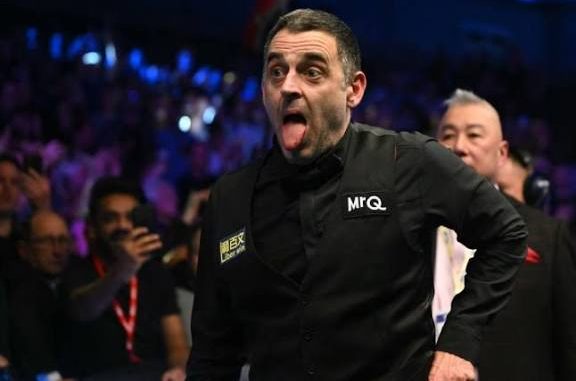
Ronnie O’Sullivan regrets ‘stupid’ comments made ahead of latest Masters title.
Ronnie O’Sullivan, one of the most decorated and charismatic figures in professional snooker, has admitted he regretted comments he made before claiming his latest Masters title, describing them as “stupid” and unnecessary. The comments came after he secured yet another prestigious Triple Crown victory — reinforcing his status as arguably the greatest player in the sport’s modern era.
At the centre of the controversy was O’Sullivan’s pre-tournament suggestion that he was aiming to achieve a rare feat: winning eight titles at each of snooker’s three Triple Crown events — the Masters, the UK Championship, and the World Championship. In interviews leading up to the Masters, O’Sullivan had openly discussed this “eight, eight, eight” target, raising eyebrows among fans and pundits for seemingly placing a numerical aspiration above the sheer enjoyment and artistry of the sport.
However, after his sensational comeback to beat Ali Carter 10–7 in the Masters final at Alexandra Palace, the 48-year-old was quick to row back on that narrative. While speaking to media following his triumph, O’Sullivan conceded that he didn’t really mean to focus so heavily on statistics. “I wish I hadn’t mentioned that stupid eight, eight, eight,” he said, characterising the remarks as something he now regretted. “I am not even interested in it, but sometimes you feel you have got to say something. Really I have no interest in numbers.”
This statement encapsulates a recurring theme in O’Sullivan’s career: a complicated relationship with expectation, legacy, and public perception. Throughout his 30-plus years at the top of the game, he has often been candid to a fault — whether that’s voicing frustration with formats, officials, or even his own motivation. In this instance, what may have been meant as light-hearted banter evolved into a distraction that even O’Sullivan himself came to dismiss.
His victory in this latest Masters final was impressive on its own merits. Despite falling behind early in the match, O’Sullivan rallied to secure the win and extend his record at the tournament. The triumph was his eighth Masters title, matching his total at the UK Championship and underscoring his remarkable consistency across decades of elite competition.
Yet even in success, O’Sullivan’s post-match reflections were tinged with ambivalence about how best to frame his achievements. He stressed that he tries not to let titles define him, explaining that snooker has been “all of my life” and that he views victories as part of a broader personal journey rather than mere numbers on a record board. He spoke candidly about the challenge of balancing his love for the game with the mental and physical demands of touring, emphasising that maintaining enjoyment is a priority over chasing milestones.
“I’ve never been driven by titles or numbers,” he said in the aftermath of his Masters success. “I just want to play well and enjoy the game. If I happen to pick up a few titles, that’s a bonus.” This frames his regret over the “stupid” comments in a broader context: while he acknowledges that media narratives often latch onto statistics, for O’Sullivan the essence of his sport remains rooted in performance, creativity, and love for the challenge.
The controversy also sparked reaction from peers and commentators. Some saw it as typical O’Sullivan — unfiltered and unpredictable — while others suggested it revealed the deep internal pressure even the most accomplished athletes place on themselves. Ali Carter, whom O’Sullivan defeated in the final, also commented on the exchange, indicating that there were mixed feelings in the snooker community about how much weight should be given to such statements.
Looking forward, O’Sullivan has indicated that he will use the momentum from his Masters win to prepare for the upcoming World Championship, though he admitted the season so far has been a unique blend of satisfaction and introspection. As always, his legacy continues to evolve — not just in the record books, but in the ongoing narrative of how one of snooker’s greatest players manages expectations, media pressure, and the personal meaning of success in a sport he has defined for generations.
Be the first to comment