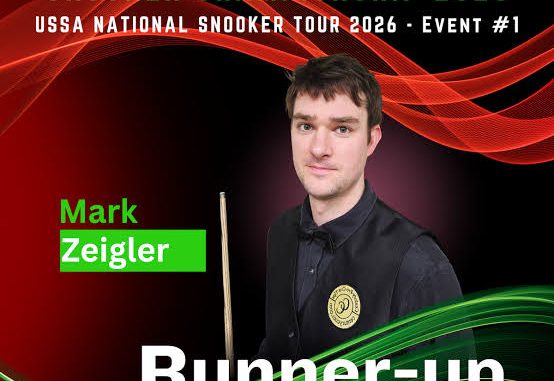
At the first stop on the United States Snooker Association’s (USSA) 2026 Tour, held this past weekend (May 16-17), Tennessee native Syed Usman went undefeated to claim the event title. Ussman defeated North Carolina’s Mark Ziegler in the finals. The event drew 7 entrants to the Nashville Snooker Academy in nearby Brentwood, TN.
With the report basics of ‘who, what, when and where’ taken care of, we’ll hit the ‘Pause’ button here before proceeding, because, as you may have noted if you frequent these AZBilliards pages, you’ll have noticed that reporting on events that have drawn 7 entrants is not usually on our ‘dance’ card. However, the event was sanctioned by the USSA (founded in 1991, with a tour that was inaugurated in 2009). The USSA is a member of the World Snooker Federation (WSF), the PanAmerican Snooker and Billiards Association (PABSA), the International Billiards and Snooker Federation (IBSF) and affiliated with the American Cue Sport Alliance (ACS), so we acted on the assumption that when the first stop on its 2026 tour (of a projected dozen stops leading to a National Snooker Championship) was announced (by us, and other media), it was something that we should look into. That, combined with the fact that our Web site is not known as AZ8ball9ball10ball,OnePocketHeyball, we deemed it prudent and worth time to report on the event in the pages of AZBilliards.
So, we called up the folks at the Nashville Snooker Academy to track down all the pertinent information regarding the event; its competitors, results, payouts and photos. Imagine our surprise when the ‘folks’ at the Academy turned out to be one guy and that his Academy was a well-appointed room with a single snooker table in a large, second floor to his garage in Brentwood, TN, a suburb of Nashville.
His name is Zia Sheik and he is the sole proprietor of the Nashville Snooker Academy, which has been running snooker events and teaching the game to those with interest in the Nashville area (and elsewhere) for the past three years (August ’23 to present day). He’s organized and run the TN Snooker Championships three times, beginning in 2024 and won the first two.
How, one might well be asking, can a billiards sport be considered relevant enough here in the United States, when a State Championship that’s been running for three years, sanctioned by a national association (the USSA) draws only 7 entrants? And how, if the notion is expanding the profile of snooker, does one go about doing that? One player at a time, apparently.
“And that,” said Sheik, “is what I’m trying to do.”
Sheik faces some huge obstacles in the realization of that attempt, not the least of which is the standard size of the tables that the sport he’s trying promote requires to be played. It’s a ‘huge’ barrier in its own right. A standard 9 x 4 ft. pool table with a variable standard that includes space around the table so that the games can be played, making it 19 x 14 ft. of space, creates a need for about 266 sq. ft. A standard 12 x 6 ft. snooker table with its space around the table to play requires 352 sq. ft. of space, making it a difficult size to install in a local bar (sizes can vary when it comes to any kind of pool table, so the ‘table’ and ‘space’ calculations can vary as well). Combination pool hall/bar/restaurant spaces tend to be larger, but they can put a lot more 7 ft., coin-op tables in the space they do have and are not likely to even think about putting a snooker table in there, to play a game that a lot of pool players here in the US have never played before.
But here’s the ‘kicker’ for all you pool players who love the varied games that you play. About two weeks ago, The World Snooker Federation’s International Championships were held and in the Men’s Division, China’s Wu Yize walked away from the tables with a £500,000 first prize (about $627,000, US). There were, of course, a number of snooker tournaments played around the world that led to the overall championships, which, according to Sheik, average somewhere in the vicinity of $50,000 for the winner. But however you look at it, over half-a-million dollars speaks to an international popularity of the game, which, possibly, might inspire entrepreneurs, event coordinates and (hopefully, as far as Zia Sheik is concerned) sponsors to promote the game and nudge it into the general direction of mainstream.
Nashville Snooker Academy
An Explanatory ‘Side Step’ . . .
This is the part where we make an attempt to familiarize readers with the basics of snooker. If you’ve ever played the game, or been curious to look and discover how to play the game, you can safely skip over the italics portion of all this and get on with what will eventually be a ‘visit’ from Allison Fisher and some details about the TN State Snooker Championships below.
Snooker is a game of points. It’s scored like the APA amateur leagues score 9-ball matches; one point for every ball, two for the 9-ball, with competitors racing to a specified number. With snooker, competitors play ‘frames’ (snooker’s word for ‘games’) that are governed by the elimination of all of the balls (except the cue ball) on the table. There are 22 of them; the cue ball, 15 red balls and six colored balls, each with a point value. The Red balls are worth a single point and the colored balls are worth an ascending number of points; Yellow (2), Green (3), Blue (5), Brown (4), Pink (6) and Black (7).
The 15 red balls are set up on the table like a standard rack in 9-ball, 8-ball, etc. In addition, each of the colored balls rests in a specific spot on the table. Frame-play proceeds from a normal break of the central rack of 15 red balls. The basic rule of a player’s task as he/she steps to the table is to pocket a red ball, then (and only then) to pocket a colored ball of choice. That process is repeated until the rack is cleared. Once the last red ball has been pocketed, players must then pocket the remaining colored balls, in a specific order, ranging from the two-point yellow ball to the seven-point black ball.
However, there’s a further consideration on the table as play progresses. Until all of the red balls have been eliminated, any colored balls that are pocketed, return to the table in the spot where it began before the break. This process can be repeated, over and over, which can lead to a ‘perfect’ frame score, rarely achieved of 147 points, which could happen if and only if you pocket each red ball, after which you pocket the black ball, which is returned to the table before play moves on. You pocket another red, then pocket the black again (it’s been returned to the table), you pocket a red ball, black ball, etc., etc. So, 15 red balls (15 points), plus 15 black balls (105), all of the other colored balls, including the black ball, for the last time (27) equals 147 points, the ‘perfect’ frame score. A much harder task than the more standard games’ relatively simple ‘break and run’ game. It can be done, but if you’re a newcomer to the game, you probably shouldn’t expect to see it any time soon.
The players alternate turns until the ‘frame’ is complete, although if the frame arrives at a point in time, where one of the competitors is so far ahead in points, that catching the leader would be impossible, the competitor with the lower score can concede the frame. This happens a lot. The alternative being that the player with the lowest score decides to try and prevent his opponent from pocketing further balls as he/she attempts to catch up on points. That player would repeatedly employ safety shots that ‘snookers’ his opponent (leaves cue ball behind another ball in a way that prevents him from hitting the required ball, red or colored). Missed balls or pocketed cue balls incur a points penalty, so technically, with no chance of catching an opponent with more points, a player could continue snookering his opponent, pocketing a few balls and when options run out, snooker his opponent again. And again, and again. Dependent on the score at any given moment, this ‘safety’ strategy could work, with the lower-score player collecting penalties and pocketing balls on his/her turn, until such time as he has to ‘snooker’ his opponent again. Not, generally speaking, a successful maneuver, which is why concessions are common.
Dependent on the event, whether it be just a random game or moving up to sanctioned Championship levels, snooker matches are generally ‘best of’ situations. In this past weekend’s TN State Snooker Championships, the opening round was best-of-five, the semifinals were best-of-seven and the final was best-of-9.
“It’s a game you could fall in love with, under certain circumstances,” said BCA Hall of Famer, Allison Fisher, a Women’s World Snooker Champion seven times between 1985-1994, and five times the UK National Champion in the same time period. “I grew up with it (in the UK). There were Snooker clubs with tables and it was a place to mingle.”
She’d be among the first to tell you that snooker is a difficult game to learn, let alone master. It’s a much easier transition to come from snooker, to games like 9-ball, 8-ball, 10-ball, than it is to come to snooker, having played those more common games. She suspects that progress toward making it a mainstream billiards option here in the USA would be a tough ‘row to hoe,’ as they say.
“It is a very difficult game,” she said. “It’s focused on fundamentals and can be a little disconcerting to play.”
“It will,” she added, “certainly improve your fundamentals.”
As a member of the World Professional Billiards and Snooker Association, she was among a lot of people who watched (via stream) China’s Wu Yize win that most recent World Championship, in what she described as the “best snooker match she had ever seen.”
“Snooker is more like chess than it is just playing with balls,” said Zia Sheik. “It will help your thinking, because (like chess) you have to think four or five steps ahead. You will get very sharp when you play.”
Seven snooker players, meet, greet and compete at a single table in a room just large enough
Enthusiasm for snooker would appear to be encoded in Zia Sheik’s DNA. We’d go so far as to predict that if the entire pool community from Boston to LA could be injected with half of his enthusiasm, snooker would be a mainstream game by sometime next week. Listen as he writes an opening paragraph about this past weekend’s event in an e-mail to us.
“The Nashville Snooker Academy played host to an unforgettable weekend of elite cue sports, culminating in a historic performance at the Tennessee State Snooker Championship,” he wrote. “In a stunning display of precision, Syed Usman captured the state title, etching his name into the history books by completing the entire tournament without dropping a single frame.”
Usman played three shutout matches. He was one of three competitors from Tennessee. Liam Barry and Malyar Raziqi were the other two. Two were from North Carolina; Runner-up Mark Ziegler and Govinda Semeta. Krishanu Chattaraj traveled from Atlanta, GA. In a single-elimination, opening-round, best-of-5 match, Usman defeated Raziqi 3-0. In the second round, best-of-seven semifinal, he eliminated Semeta 4-0 (and in the process, earned a ‘Highest Break’ trophy for chalking up 31 straight points off of a break). In the final, best-of-seven race, Usman claimed the title over Ziegler 5-0.
It was the first time that Usman and Ziegler had reached the finals of the Tennessee event, leading Sheik to describe it as a “milestone event,” moving on to speak of Ziegler’s runner-up finish.
“Tournament debutant Mark Ziegler earned immense respect from the field,” he wrote. “His brilliant run to the final table establishes him as a premier force to watch in the region’s cue sports scene.”
Sheik has a way of making even his ‘thanks’ sound exciting.
“The spectacular execution of this weekend’s event was made possible through the unwavering support and vital contributions of the United States Snooker Association (USSA),” he wrote. “The tournament organizers express their deepest gratitude to main sponsor Ugadi IndiaGrill, supporting sponsor Zfinity Global and Century Cue Tips (who provide for the event’s trophies) for their foundational investment in growing the sport.
“Without their dedication to the snooker community,” he added, “staging a championship of this caliber would not be possible.”
The next stop on the US Snooker Association Tour, scheduled for the weekend of May 29-31, will be the Wiraka Colorado Snooker Open (Wiraka is a snooker table manufacturer). The event will be hosted by the Hampton Inn and Suites in Boulder, CO.
Individuals who would like further information about Snooker and its efforts to raise the profile of this billiards discipline, can do so in a number of ways. Be prepared, because Zia Sheik of the Nashville Snooker Academy will, for sure, get you excited about the game and its potential here in the US.


Be the first to comment