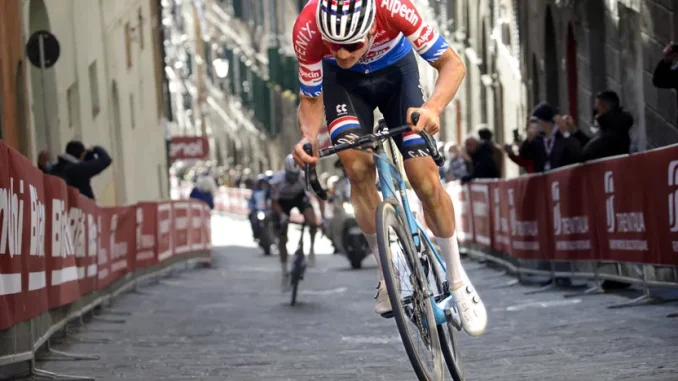
Strade Bianche has become increasingly demanding in recent years, and that shift is one of the main reasons Mathieu van der Poel will not compete in the 2026 edition, according to his team.
The Dutch rider showed strong early-season form at Omloop Het Nieuwsblad and is scheduled to begin Tirreno‑Adriatico on March 9. However, he is missing from the start list for Strade Bianche. Christoph Roodhooft explained that the race’s increasing difficulty and Van der Poel’s training priorities influenced the decision.
Many fans still remember his dramatic 2021 victory in Siena. During that race, Van der Poel attacked on the final gravel sector alongside Julian Alaphilippe and Egan Bernal. On the steep Via Santa Caterina climb, he surged clear of both rivals before riding solo into Piazza del Campo to claim the win his third triumph in a major one-day Classic after victories at the Amstel Gold Race in 2019 and the Tour of Flanders in 2020.
Despite once calling Strade Bianche one of the most beautiful races on the calendar—fitting for a rider who thrives on terrain similar to cyclocross and mountain biking—Van der Poel has rarely returned since that victory. His only appearance afterward came in 2023, when he finished 15th, more than a minute behind winner Tom Pidcock.
Roodhooft said Van der Poel also needs a dedicated training block. The rider recently completed an altitude camp before Omloop, and the eight days between that race and Tirreno-Adriatico are considered crucial preparation time. Racing Strade Bianche would reduce those training days and leave only a single day to recover before the stage race, which is not ideal given his demanding schedule in April.
Another factor is the race’s evolution. Organisers have gradually increased the climbing over the years. When Van der Poel won in 2021, the elevation gain was significantly lower, but recent editions have seen a jump of roughly 20–25 percent. Totals that once hovered around 3,300 metres now approach or exceed 3,900 metres, and last season was estimated at around 4,200 metres. Even with a slightly shorter course this year, the climbing still surpasses 3,500 metres.
Roodhooft believes the course now pushes beyond the limits that once suited explosive Classics specialists like Van der Poel. The level of competition is also tougher, with riders such as Pidcock and Tadej Pogačar capable of dominating the race when at their peak. In that scenario, the team feels it is more beneficial for Van der Poel to focus on other targets rather than Strade Bianche.

Be the first to comment