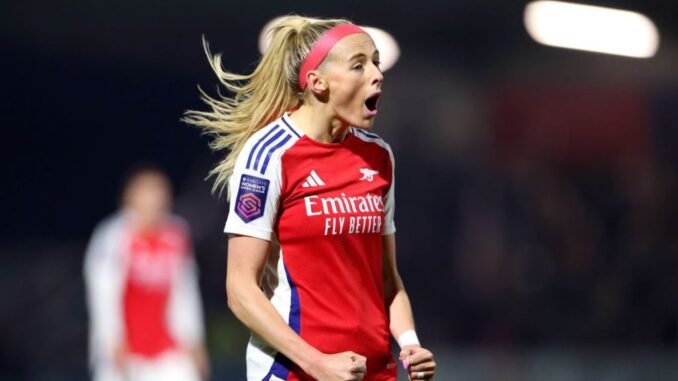
EXCLUSIVE: ‘Fat clubs’ and eating disorders – how Arsenal star Chloe Kelly shone a light on football’s body image issues
When Arsenal and England forward Chloe Kelly recently spoke out about “fat clubs” in women’s football, it was more than just a personal anecdote—it was a powerful spotlight on a damaging culture that many players endure behind the scenes. Her remarks open up a conversation about mental health, body image pressures, and the hidden costs of elite sport.
Kelly, while insisting she has not struggled with body image herself, described seeing teammates subjected to what she calls “fat clubs” at previous clubs. These are informal labels given to players deemed to have too much body fat; the consequence is that those players are shamed, asked to lose weight, or treated differently by coaching staff.
She observed teammates “losing so much weight and being so unhappy and obsessed,” and she expressed regret that she “could have done more” to help. For Kelly, the troubling part isn’t just the weight loss—it’s how it happens, how players are pressured, and how quickly it becomes about appearance rather than performance or well‑being.
Kelly’s critique comes amid increasing concern in the Women’s Super League (WSL) and beyond around disordered eating and fat‑shaming. One investigation revealed that some clubs use weight charts, daily weigh‑ins, body‑fat testing, and “fat club” colour codings to determine who needs extra training or punishment. Players told researchers that being flagged “in the red” could mean going without carbohydrates or social exclusion.
Experts warn that such practices are not just harmful—they carry real risks. Disordered eating behaviours (obsessing about weight, restricting food, guilt after eating), burnout, mental health strains, and even more serious eating disorders can emerge under sustained pressure.
When Arsenal and England forward Chloe Kelly recently spoke out about “fat clubs” in women’s football, it was more than just a personal anecdote—it was a powerful spotlight on a damaging culture that many players endure behind the scenes. Her remarks open up a conversation about mental health, body image pressures, and the hidden costs of elite sport.of player welfare, nutrition, and mental health. But she emphasises that this is not just about rules—it’s about culture. She wants the focus to shift away from how players look, and instead centre on health, performance, and what makes each individual happy and physically sustainable.
This matters most for young players, who often internalise images or standards of ideal body shapes. If they see senior teammates punished or shamed for being “too fat” (even when within healthy norms), it sends a signal: weight matters over strength; appearance over function. Kelly’s voice, in this context, becomes one of advocacy—not just for herself, but for those whose stories go untold.
Her intervention underscores that the women’s game cannot thrive if players are pushed into extremes for the sake of perceived “fitness” or aesthetics. Safety, joy, and mental health must be seen as equally essential to physical training and tactical coaching. If “fat clubs” are allowed to persist, the cost might be more players’ well‑being than goals.



Be the first to comment