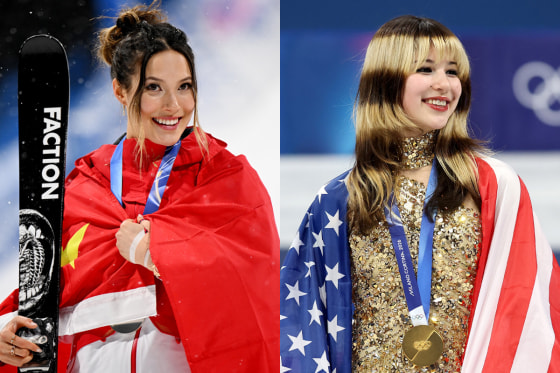
At the Milan Cortina 2026 Winter Games, American figure skater Alysa Liu and freestyle skier Eileen Gu found themselves unintentionally cast in a political and cultural comparison following Liu’s historic victory.
After Liu captured the United States’ first Olympic women’s figure skating gold in 24 years with a powerful free skate performance, social media and some political commentators quickly contrasted her with Gu. Liu, a California native competing for Team USA, was juxtaposed with Gu, also raised in California, who represents China in international competition.
The comparisons gained traction in conservative circles, with critics framing the athletes’ differing national allegiances in stark terms. Sociology professor Christina Chin of Cal State Fullerton criticized the narrative, noting that two athletes from entirely different disciplines were being racially and politically compared in a reductive way. She described the discourse as reinforcing a “good Asian, bad Asian” dichotomy, arguing that Asian American athletes are often judged through a racialized lens distinct from that applied to white competitors.
Gu, born in Northern California to a Chinese immigrant mother, has competed for the People’s Republic of China for two Olympic cycles. She previously won two gold medals and a silver at the Beijing Games and has since added two silvers in Italy. Her decision has drawn sustained criticism in the United States, particularly amid heightened U.S.-China tensions.
Reports have also highlighted substantial financial backing for athletes representing China, adding further scrutiny. Some U.S. lawmakers publicly rebuked Gu, questioning her loyalty and suggesting consequences for Americans who compete under rival flags.
In contrast, Liu’s personal story including her father’s history as a Chinese dissident who fled after the 1989 Tiananmen Square crackdown intensified the symbolic weight placed on her victory. Liu, who briefly retired from skating at age 16 before returning to the sport, described her Olympic triumph as surreal, saying she was still absorbing the moment.
The phrase “Be an Alysa Liu” began trending online, with posts contrasting the two athletes amassing significant engagement. Chin emphasized that such reactions reflect broader issues around identity and belonging, arguing that Asian American athletes frequently face questions about their authenticity and national loyalty.
Gu, who is set to compete again in the women’s halfpipe event, has defended her decision, saying she feels unfairly targeted. She noted that many athletes represent countries other than their birthplace, but believes criticism toward her is amplified by political hostility toward China.
Vice President JD Vance, when asked about Gu, stated he supports athletes who identify as American, underscoring how the debate has extended beyond sports into the political arena.
Though neither athlete sought the comparison, their Olympic journeys have become entwined in a broader conversation about nationality, race, and geopolitics on one of the world’s largest stages.
Be the first to comment