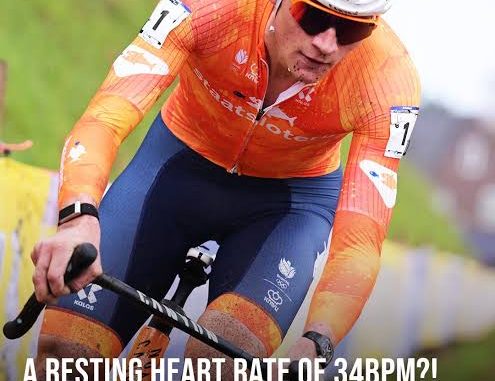
Mathieu van der Poel has revealed some of the statistics around his heart rate that point to his supremely high fitness levels and ability to recover.
Dutch cycling star Mathieu van der Poel, the dominant force in road racing, cyclocross and mountain biking, recently offered an unusually transparent look at his physiological data, particularly heart rate variability (HRV) and resting heart rate (RHR), during a conversation on the WHOOP podcast with the wearable tech company’s founder. These figures, and his discussion of how he manages them, illuminate why he’s able to perform at the absolute pinnacle across disciplines.
At the heart of the story are two numbers that many athletes obsess over — but few share publicly. One is heart rate variability (HRV), a measure of how much the time between individual heartbeats varies. In general, a higher HRV is associated with better autonomic nervous system balance, greater resilience to stress, and superior recovery from training — all hallmarks of world-class endurance fitness. Van der Poel reports that his HRV “regularly exceeds 200 milliseconds,” a figure that most men never come close to without years of elite conditioning and often genetic advantages. For context, average HRV scores for recreational athletes are typically in the range of 50–80 ms.
The second standout metric is his resting heart rate, a classic indicator of cardiovascular efficiency. Van der Poel says his typical average is around 38 beats per minute (bpm), with his lowest recorded by his WHOOP device just 34 bpm. Such low resting heart rates are virtually unheard of outside elite endurance athletes. A heart that beats less often at rest is generally understood to pump more effectively — delivering the same volume of blood with fewer beats, which is a sign of a highly efficient cardiovascular system.
Van der Poel himself pointed out that these values are partly thanks to genetics — something he shares with his father and grandfather, both accomplished cyclists — but also the product of years of dedicated training and physical conditioning. He says his HRV and resting heart rate are the “two most important numbers” he monitors on WHOOP, giving him a snapshot of how ready his body is to handle stress and exertion on any given day.
Unlike many elite athletes who treat their biometric data like a secret weapon, van der Poel has no qualms about sharing his numbers publicly. He believes that even if competitors see these metrics, it’s unlikely to provide any real advantage. Instead, he sees value in transparency — and perhaps in inspiring others to think more scientifically about fitness, recovery and training.
Beyond the raw numbers, van der Poel also shared some of the practical lifestyle strategies he uses to maintain his high recovery scores. He avoids red meat and alcohol during the competitive season, both of which he has noticed can negatively impact his recovery metrics. He also takes magnesium supplements before bed to promote muscle relaxation and has a consistent bedtime ritual that includes reading — a combination he says helps him fall asleep faster and optimizes his recovery overnight.
His approach underscores an important point: elite performance isn’t just about training harder — it’s about training smarter. Monitoring detailed physiological data allows van der Poel to fine-tune his workload, rest periods and lifestyle choices in a way that keeps his body at peak condition across a grueling racing calendar that spans multiple cycling disciplines.
In sum, the statistics van der Poel has revealed offer a rare window into the physiology of one of cycling’s most versatile and successful athletes — and underline how exceptional his fitness and recovery capability really are.



Be the first to comment