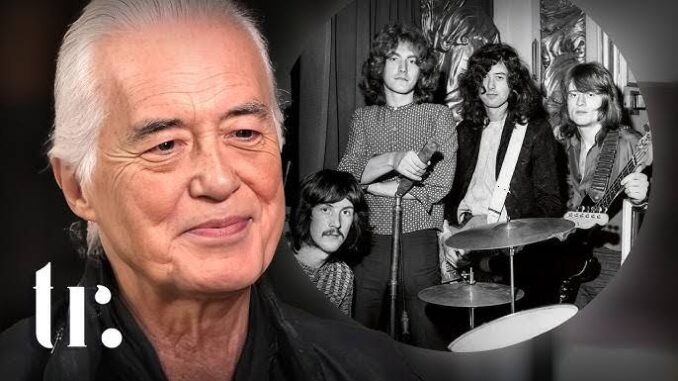
Becoming Led Zeppelin’ Filmmakers Passed 7-Hour Jimmy Page “Exam” To Get His Cooperation – Contenders Documentary.
Becoming Led Zeppelin is a 2025 documentary directed by Bernard MacMahon (with co-writer/producer Allison McGourty), chronicling the early formation and meteoric rise of Led Zeppelin. It represents the first time the legendary band has officially sanctioned a biographical film — and it features participation from the surviving band members.
The film focuses on the band’s origins in the late 1960s, their first rehearsals and performances, the coming together of the members, and their rapid ascent to fame. It draws on rare archival material (including audio tapes and early interviews) and tells the story largely in the band’s own words.
Why Jimmy Page Was Wary — And Demanded Proof
The surviving members of Led Zeppelin have long been protective of their legacy. According to MacMahon, when they first approached Page in late 2017, there was a real possibility he’d simply decline — especially given that over the years “a lot of … pretty miserable pitches” had been made to produce a Zeppelin film.
When Page agreed to a meeting at a London hotel, however, things quickly turned serious. He arrived carrying what appeared to be grocery bags from Waitrose — which MacMahon initially assumed held sandwiches or snacks. Instead, Page revealed they contained his personal diaries dating back to the 1960s.
As MacMahon laid out the storyboard for the film — a leather-bound book showing pictures (but no text), charting how the film would unfold — Page began testing him. The session lasted seven hours, with an afternoon-tea break. “It was almost like an exam,” McGourty recalled, as Page fired questions testing their knowledge of the band’s early history.
For example, Page asked: “What was the name of Robert’s group when I first met him?” When MacMahon answered “Obs-Tweedle” (some sources spell it “Hobbstweedly”) correctly, Page responded: “Very good — carry on.”
Other questions tested dates, early gigs, and events; it was a comprehensive screening to ensure the filmmakers truly understood the band’s history, context, and legacy before earning their trust.
What Passing the “Exam” Got Them — And Why It Matters
Their success in that first marathon meeting was more than symbolic. By passing the test, MacMahon and McGourty earned Page’s trust — which opened the door to cooperation from the rest of the band. Page reportedly said, “I’m in — but you have to get the others on board.”
Soon after, Page even took the filmmakers on a symbolic trip: a visit to a boathouse in Pangbourne where he once lived — a spot tied to early rehearsals and memories from Zeppelin’s formative days. That visit also turned out to be another trust test of sorts.
Once the rest of the members — including John Paul Jones and Robert Plant — heard about the rigor, they felt more comfortable participating. John Paul Jones reportedly granted the filmmakers full editorial control — a rare gesture for the notoriously private band.
As a result, the documentary gained access to previously unseen material: diaries, rare interviews, and archival audio (including a long-lost interview with late drummer John Bonham). Some of these sources had not been heard or seen publicly in decades — and helped give the documentary a sense of authenticity and intimacy.
Why This “Test” Is Significant — For Fans and Documentary Filmmaking
It shows how protective Page — and by extension the band — still is of their legacy. The fact that they treated the opening meeting as an exam suggests deep caution and a need for genuine respect and understanding before entrusting their story to outsiders.
It underscores the lengths honest documentary-makers must go to earn trust. For MacMahon and McGourty, decades of research and genuine passion for the music paid off — only because they knew enough to pass Page’s questions.
It enhances the legitimacy of the result. Because the documentary was created with the band’s cooperation, and based on rare primary materials, it arguably offers one of the most faithful, insider-approved portrayals of the band’s early history.
As MacMahon put it, when he first read about the band as an 11-year-old — before even hearing a single song — he was hooked. That early fascination drove him years later to meticulously prepare for this project. Passing the “seven-hour exam” was perhaps proof not just of knowledge, but of dedication and respect.


Be the first to comment