
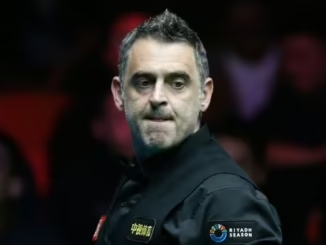
Why pundits aren’t convinced Ronnie O’Sullivan can win a ninth UK Championship.
Despite being widely regarded as the greatest snooker player of all time, Ronnie O’Sullivan enters every UK Championship under a cloud of uncertainty—an uncertainty that fuels scepticism among pundits year after year. While his talent is unquestionable, the reasons behind the persistent doubt are rooted in form, motivation, age, and the unique dynamics of this event.
A major factor is O’Sullivan’s inconsistent engagement with tournaments. Pundits frequently highlight that, for all his brilliance, he rarely sustains peak focus throughout an event unless he feels motivated. The UK Championship is long, mentally draining, and played in a format that punishes lapses in concentration. Even when O’Sullivan wins, he often admits he wasn’t fully committed, a candour that fuels sceptics. Many believe that unless he arrives in York with genuine appetite—rather than treating the event as just another stop on the calendar—his chances remain vulnerable.
Another point regularly raised is his age and shifting priorities. At 49, O’Sullivan’s longevity continues to astonish, but pundits know that physical and mental stamina inevitably become harder to maintain. While he can still produce passages of snooker that eclipse anyone, doing so across two weeks is a different challenge. His selective schedule, which helps preserve his energy, also means he sometimes enters major events lacking competitive sharpness. The UK Championship traditionally rewards players who have been active, match-tight, and in strong rhythm.
There is also the matter of increasing competition. O’Sullivan once dominated fields largely intimidated by his presence. Today’s landscape is different. Players like Judd Trump, Mark Allen, Mark Selby, and younger contenders bring a level of consistency and tactical discipline that narrows margins. Many pundits argue that while O’Sullivan can still reach heights his rivals cannot, they are more likely to produce stable match-winning form across multiple rounds. In a tournament where one bad session can end a campaign, consistency often beats brilliance.
His relationship with the UK Championship itself also contributes to the scepticism. Though he has won the event seven times, he has spoken openly about disliking aspects of it—particularly the crowded calendar and the demands associated with Triple Crown scrutiny. At times, his body language during this event has appeared detached, and pundits have learned to judge not his talent but his mood.
Finally, there is the intangible yet crucial matter of motivation versus legacy. O’Sullivan’s legacy no longer depends on accumulating titles. He has said repeatedly that he values enjoyment over achievement at this stage of his career. While that mentality is admirable, it does not always align with the ruthlessness required to win a major. Pundits know that players who crave titles often have a psychological edge over someone who feels he has nothing left to prove.
None of these doubts diminish O’Sullivan’s ability to produce a title-winning run—he has defied sceptics before and may do so again. But until he demonstrates sustained focus, commitment, and form across the entire tournament, many pundits will continue to hesitate before backing him for a ninth UK Championship.


Be the first to comment